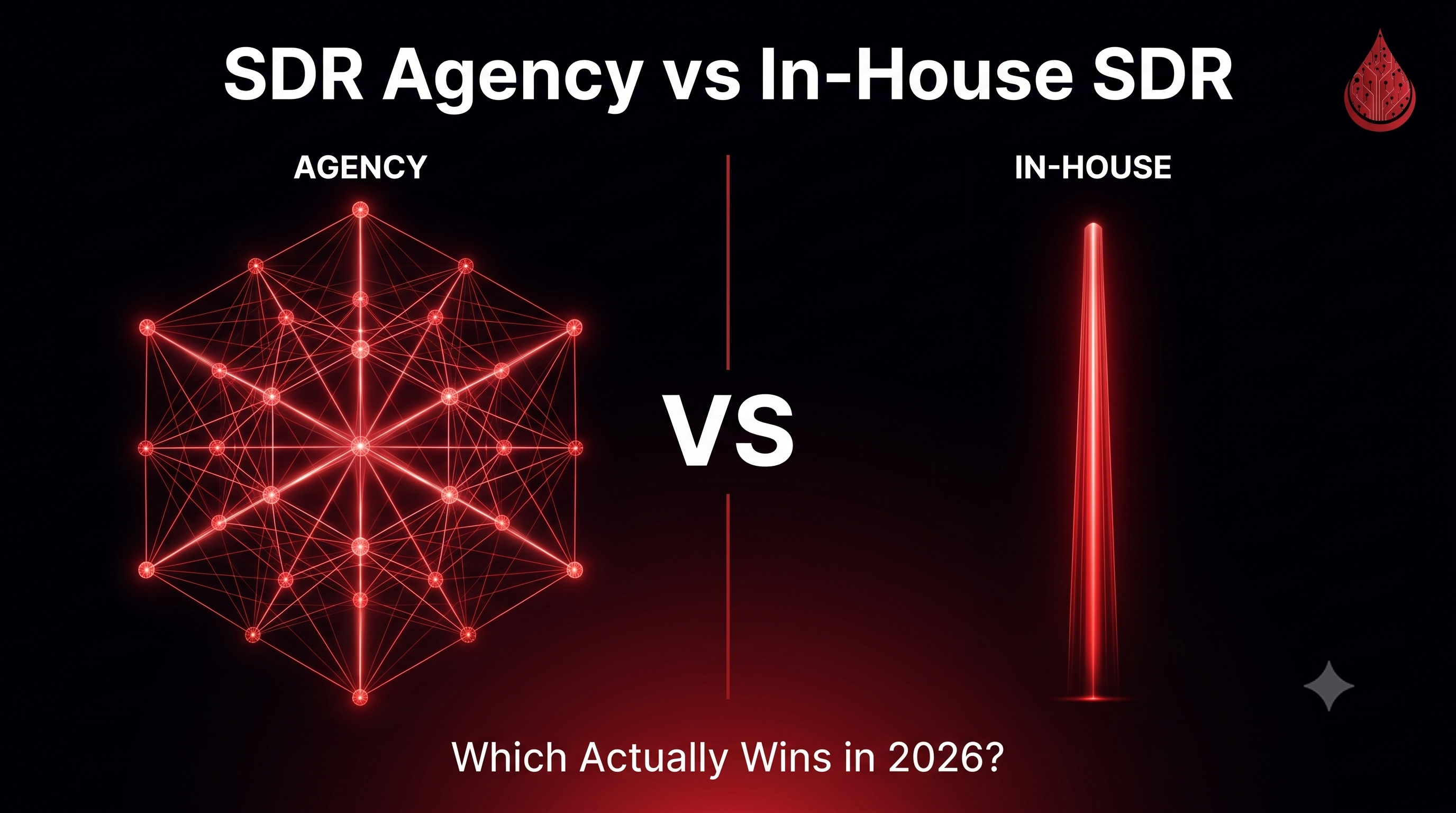
- • In-house SDR: $135K–$220K fully loaded, 3–6 months to ramp, 34% annual churn, builds long-term institutional knowledge.
- • SDR agency: $3K–$8K/month, meetings in 1–2 weeks, no ramp, no HR overhead — you're renting the skill, not building it.
- • The "which is cheaper" question is misleading. Over 12 months, agencies often win on cost per meeting; in-house wins on long-term strategic value.
- • Most $10M+ B2B teams run BOTH — 1–2 senior in-house SDRs for strategic accounts, agency for volume and new-segment testing.
- • Fastest way to know which is right: can you afford to wait 4–6 months for the first qualified meeting? If no, hire an agency. If yes, and you have sales leadership, build in-house.
Every "SDR agency vs in-house" article online is written by someone with skin in one of the two games — either an agency selling you their service, or an in-house sales leader explaining why their model is superior. Both are useful. Neither is honest about the whole picture.
This piece is written by an agency (BleedAI runs cold outbound as a service). We're biased. We've compensated by using publicly-verifiable data from Bridge Group and RepVue instead of our own cherry-picked stats, and by explicitly telling you when in-house is genuinely the better call. If you spot spin, email us — we'll fix it.
The question isn't which model is universally better. It's which model fits your stage, your offer, and your urgency.
How we compared these
The numbers below come from:
- Bridge Group's 2024 SDR Metrics Report — the industry-standard survey of 400+ B2B SDR teams for cost, ramp time, and quota attainment data
- RepVue's 2025 B2B SDR salary data — for base + OTE benchmarks
- Public agency pricing pages — sanity-checked against our own client intake calls (we know what other agencies quote because prospects tell us during evaluation)
- Our own agency cost structure — for the agency-side numbers
What we deliberately ignored:
- Vendor case studies (self-selected, cherry-picked)
- LinkedIn thought-leadership posts about "the future of outbound" (usually written to sell something)
- Reddit threads (useful for specific bugs, useless for structural comparisons)
If you only read one section, jump to the 60-second answer below. The rest is for anyone who needs to defend the decision in a board deck.
The 60-second answer
Pick an in-house SDR team if:
- You've raised $10M+ and have a VP of Sales who has scaled an SDR org before
- Your sales cycle is highly technical or product-led — only insiders can qualify meetings correctly
- Your offer + ICP is stable and you need repeatable volume from institutional knowledge
- You can absorb 3–6 months of ramp time before the first meeting
Pick an SDR agency if:
- You're seed to Series A, or bootstrapped, and every month of runway matters
- You're validating a new ICP, offer, or geography and don't want to hire on speculation
- You need meetings booked in 1–2 weeks, not 3–6 months
- Your sales leadership doesn't have SDR-management experience
Do both if:
- You're at $10M+ ARR with a mature sales org
- You want in-house owning strategic accounts and complex qualification
- You want an agency owning top-of-funnel volume and new-segment testing
- You want to hedge against SDR churn (agencies don't quit at 3 AM)
The rest of this article is the "why" behind those calls.
We run The Outbound Sprint: up to 8 cold email experiments in 6 weeks, one fixed price.
In-house SDR: what it actually costs and what you get
What "in-house SDR" actually means: a full-time employee, on your payroll, sitting in your Slack, using your ICP, reporting to your sales leadership. They typically own everything: list-building, outreach, follow-up, qualification, meeting booking, and often light discovery calls.
Real fully-loaded cost (per rep, per year, in 2026):
| Line item | Cost range | Notes |
|---|---|---|
| Base salary | $60,000 – $90,000 | Higher in NYC/SF/Boston; lower in Austin/Denver/remote |
| Variable comp (OTE) | $40,000 – $60,000 | Typically 30–40% of base at 100% quota attainment |
| Tooling stack | $20,000 – $40,000 | Apollo/Clay ($400–2K/mo) + Salesforce/HubSpot seat ($150/mo) + sequencer like Outreach/Salesloft ($120–200/mo) + LinkedIn Sales Nav ($100/mo) + call recording (Gong/Chorus $150/mo) — adds up fast |
| Infrastructure | $15,000 – $30,000 | Domains, inboxes, warming services, deliverability tools — this line is what most founders forget |
| Manager overhead | $8,000 – $20,000 | 10–15% of a sales manager's time managing the SDR, quota-setting, coaching |
| Recruiting | $8,000 – $15,000 | Amortized cost of hiring — recruiter fees or in-house recruiter time; higher if you use an agency |
| Total | $151,000 – $255,000/yr | Per rep, before benefits and taxes (add 25–30%) |
Pros:
- Owns institutional knowledge — after 12 months, they know your product, ICP, and objection patterns better than any outsider
- Can handle complex qualification your outsider can't
- Culture fit — sits in retros, contributes to strategy, becomes a leader
- Long-term: you're building a sales org, not renting one
Cons:
- 3–6 months to ramp. Per Bridge Group, only 26% of SDRs hit quota in their first 90 days.
- 34% annual churn (Bridge Group 2024). That's roughly a third of your team turning over every year, which means you're perpetually training.
- 45–60 days to hire. Time-to-hire is a hidden cost most founders under-estimate.
- Locks up manager bandwidth. Every SDR takes 3–6 hours/week of manager attention.
Most founders quote the base salary ($75K) as "what an SDR costs" and stop there. The tooling + infrastructure line is usually 30–40% of the real number, and it's the line new sales leaders discover the hard way — 3 months in, when the first campaign burns their primary domain and they have to pay for infra recovery.
Best for: Series B+ teams with $10M+ ARR, mature sales leadership, complex/technical products, and stable ICP where you need long-term repeatable volume.
Not for: Founder-led sales orgs pre-Series A, teams testing new ICPs, teams that need meetings THIS month.
SDR Agency: what it actually costs and what you get
What "SDR agency" actually means: an external team you contract with. They own the infrastructure, the tooling, the reps, the campaign management, and often the copy and list-building. You brief them on ICP + offer, they run the campaigns, meetings land in your calendar.
Real fully-loaded cost (per month, in 2026):
| Tier | Monthly cost | What you get | Best for |
|---|---|---|---|
| Subscription/productized (e.g. Cleverly) | $1,500 – $3,000 | Set volume, minimal customization, self-service dashboards | Seed-stage teams, clear ICP, simple offer |
| Mid-market DFY (e.g. BleedAI, Martal) | $3,000 – $8,000 | Custom strategy, offer/copy iteration, dedicated account manager, owned warm infrastructure | Series A/B teams, complex ICP, offer still being validated |
| Enterprise per-meeting (e.g. Belkins) | $300 – $700 per booked meeting | Guaranteed meeting volume, boutique service, integrated with your CRM | Enterprise sales teams that need a predictable meeting pipeline |
Fully-loaded annual: $18K (subscription) to $60K–$96K (mid-market) to $100K+ (enterprise). Compare to $150K–$220K for a single in-house SDR.
Pros:
- Meetings in 1–2 weeks. No 45-day hiring cycle, no 3-month ramp.
- Owns infrastructure. Reputable agencies (BleedAI, Belkins, Martal, CIENCE) send from their own pre-warmed secondary domains — your primary domain reputation stays clean.
- De-risks experimentation. Want to test a new segment? Agency runs a pilot campaign for $683–$5K. Same experiment in-house means hiring an SDR you might not need in 6 months.
- No HR overhead. Sick days, PTO, benefits, comp reviews, terminations — not your problem.
- Learning across accounts. Good agencies see 30+ campaigns per year across industries; that pattern-matching is hard to replicate in-house.
Cons:
- You don't own the institutional knowledge. When the contract ends, so does the accumulated learning about your ICP.
- Quality varies wildly. A bad agency can be worse than no agency (burned domains, spammed prospects, damaged brand). Due diligence matters.
- Contract lock-ins. Many agencies require 6–12 month minimums. Confidence shows up in contract length — the good ones offer pilots.
- Culture disconnect. An agency rep will never care about your company the way an employee does. This matters more for complex enterprise sales than for volume outreach.
The "agencies don't care as much" argument is real but overstated. What actually matters: how detailed your ICP brief is, how tightly you enforce qualification criteria, and how often you have a weekly sync. A well-briefed agency outperforms a poorly-briefed in-house SDR every time.
Best for: Pre-Series-B teams, teams validating new segments, teams that need speed over long-term ownership, teams without sales-management bandwidth to hire and train.
Not for: Highly technical products where only insiders can qualify meetings, enterprise sales orgs with mature in-house SDR functions already dialed in.
Head-to-head comparison
| Dimension | In-House SDR | SDR Agency |
|---|---|---|
| Fully-loaded annual cost | $151K – $255K | $18K – $96K (mid-market) |
| Time to first meeting | 90–120 days | 7–14 days |
| Ramp to full productivity | 3–6 months | Immediate (agency's team is already ramped) |
| Institutional knowledge | ✅ Builds long-term | ❌ Rented, ends with contract |
| Infrastructure risk | ⚠️ Your primary domain unless you set up secondary infra correctly | ✅ Agency's warm domains — your domain stays clean |
| Culture fit / product depth | ✅ High after 6 months | ⚠️ Requires strong brief + weekly sync |
| HR overhead | ⚠️ Recruiting, comp, PTO, churn | ✅ Zero |
| Flexibility | ❌ Can't scale down without layoffs | ✅ Pause or resize anytime (contract permitting) |
| Best for | Series B+, stable ICP, complex qualification | Seed–Series B, ICP testing, speed |
We run The Outbound Sprint: up to 8 cold email experiments in 6 weeks, one fixed price.
The real cost breakdown over 12 months
Assume you need "5 SDRs worth" of output over 12 months.
| Approach | Annual cost | Months productive | Effective cost per productive month |
|---|---|---|---|
| 5 in-house SDRs | $750K – $1.1M | ~7 months (accounting for ramp) | ~$25K–$30K/month/rep for productive output |
| 5-SDR-equivalent agency | $60K – $96K | 12 months | $5K–$8K/month for productive output |
| Hybrid: 2 in-house + agency | $360K – $560K | 12 months on agency, 7 on in-house | $30K–$45K/month total for 3–5x output |
The pure agency route is dramatically cheaper for equivalent throughput. The in-house route wins on long-term strategic value and account ownership. The hybrid wins on total output.
Where the "hybrid" model actually shines
The reality most sales leaders don't publicly discuss: at $10M+ ARR, virtually every successful B2B outbound org runs both models simultaneously.
Structure that works most often:
- 1–2 senior in-house SDRs — assigned to top-tier target accounts (Fortune 5000, strategic partnerships, competitive displacement plays). These accounts are too valuable to hand to an agency. In-house reps handle the multi-touch, multi-stakeholder qualification that outsiders can't.
- Agency for volume — everything below the top 100 target accounts. Agency runs signal-based campaigns across mid-market and SMB segments, feeding qualified meetings back to a dedicated in-house AE.
- In-house SDR = 20% of accounts, 60% of pipeline value. Agency = 80% of accounts, 40% of pipeline value. Both matter.
The hybrid model is roughly 30% more expensive per month than pure in-house — but produces 2–3x the pipeline. If your unit economics allow, it's almost always the right answer at scale.
Recommendations by your situation
If you're trying to skip ahead, here's the punchline based on your business shape:
| Your situation | Pick | Why |
|---|---|---|
| Pre-seed / Seed, $0–$1M ARR | Agency (pilot tier) | Every dollar to product; agency validates your outbound thesis before you hire |
| Series A, $1M–$5M ARR, no VP Sales | Agency (mid-market DFY) | You don't have the sales leadership to hire + manage SDRs yet |
| Series A, $1M–$5M ARR, VP Sales just hired | Agency for now, 1 in-house SDR in Q3 | Give the VP time to build infra; hire strategically |
| Series B, $5M–$20M ARR | Hybrid (1–2 in-house + agency) | Best-of-both economics; hedges churn risk |
| Series C+, $20M+ ARR | Full in-house team + agency for new-segment tests | You've earned the right to a full in-house SDR org; keep an agency on retainer for experiments |
| Bootstrapped, focused on efficiency | Agency | Fastest path to positive unit economics on outbound |
| Highly technical / product-led sales | In-house | Only your engineers-turned-SDRs can qualify these meetings correctly |
| Testing a new segment / geography / offer | Agency (short-term pilot) | Don't hire an FTE for an experiment |
We run The Outbound Sprint: up to 8 cold email experiments in 6 weeks, one fixed price.
How to actually pick
Five filters in order:
- Timeline gate. If you can't afford to wait 4–6 months for the first meeting, in-house is off the table. Pick an agency.
- Sales leadership gate. If you don't have someone who has managed an SDR team before, agency (or hire the VP first). SDR hires without experienced management fail 70% of the time.
- Product complexity gate. If your product requires deep technical qualification, in-house wins. If it's a repeatable playbook, agency wins.
- Unit economics gate. Does your LTV support $150K/rep/year? Under $5K LTV, in-house math gets hard. Agency scales down more gracefully.
- Strategic value gate. Are these accounts you MUST own institutionally (competitors, partners, strategic clients)? Those go in-house. Everything else can go to an agency.
Ask yourself these two questions in order:
- "Do we have the sales leadership to hire, train, and manage SDRs right now?" — if no, agency by default.
- "Can we afford to wait 4–6 months before the first qualified meeting appears?" — if no, agency by default.
Two "no" answers eliminate the in-house option immediately.
Where BleedAI fits — and where we don't
Since this is our blog, here's the honest version:
- You're B2B SaaS, agency, consultancy, or services with $5K+ LTV and at least 20K prospects in your TAM
- You want to validate the offer + ICP before committing to a full in-house build
- You need meetings in 1–2 weeks, not 4–6 months
- You want transparent pricing (we publish it via our cost calculator — no "book a call to learn our rates")
- You're at Series B+ with $10M+ ARR and have a VP of Sales who has scaled SDR teams before
- Your product is highly technical — only insiders can qualify meetings correctly
- You have strategic accounts (competitor displacements, partnerships) that are too valuable to hand to any outsider
- You've already run a successful agency pilot and are ready to graduate to owned infrastructure
Translation: we're not the right fit for every stage. For early-stage teams, we're a faster, cheaper path to validated outbound than hiring an SDR. For late-stage teams, we complement your in-house SDR org — we don't replace it.
If we sound like the right fit for your stage, check out The Outbound Sprint: a fixed-price way to test cold email before committing to more.
Final thoughts
The wrong question is "agency or in-house — which is better?" The right question is "what does my current stage require, and what will my next stage require?"
Most teams answer "in-house" because it feels more legitimate ("we're serious about sales"). Most teams should answer "agency" because they're pre-Series-B, don't have a VP of Sales, and can't afford six months of quiet before the first meeting.
Then, when the agency has proved outbound works for your offer, you graduate — build 1–2 senior in-house SDRs for strategic accounts, keep the agency running for volume, and become one of the many $10M+ B2B teams that discovered the hybrid model is quietly the most efficient version of this whole system.
1. "Do we have the sales leadership to hire, train, and manage SDRs right now?"
2. "Can we afford 4–6 months of ramp before the first qualified meeting?"
Two "no" answers eliminate in-house immediately. Two "yes" answers make in-house genuinely viable. One of each? The hybrid model.
Whichever way you go, the biggest predictor of success isn't the model — it's the rigor of the ICP definition and the discipline of the qualification criteria. Agencies with sharp briefs outperform in-house SDRs with vague ones. In-house SDRs with strong management outperform agencies with lax accountability. Get the fundamentals right, then pick the vehicle.
Ready to put this into practice?
Start Your SprintFrequently Asked Questions
$135K–$220K per rep per year. That's base salary ($60–90K) + variable comp / OTE bonuses ($40–60K) + tooling stack ($20–40K: Apollo/Clay + Salesforce/HubSpot + sequencer + LinkedIn Sales Navigator) + infrastructure ($15–30K: domains, inboxes, warming). Most founders quote the base salary and stop there — the tooling + infra is usually 30–40% of the real number.
3–6 months on average, per Bridge Group's SDR benchmarks. First month is onboarding + training, months 2–3 are ramp (30–50% of quota), months 4–6 are approach-to-quota. Meanwhile SDR churn averages ~34% annually, so a chunk of reps leave before they're profitable. Agencies deliver first meetings in 1–2 weeks — the trade-off is you're renting the skill, not building it.
Per month, sometimes. But agencies deliver meetings from day 7, while an in-house SDR delivers meetings from month 3–4. Over 12 months, an in-house SDR at $150K fully loaded costs you $150K for maybe 6 months of productivity — effectively $25K/month for productive output. A $6K/month agency delivering meetings for all 12 months costs $72K. The math flips when you factor in ramp time.
It's a myth that gets repeated. Quality depends on whether the agency has your ICP dialed and your qualification criteria enforced — not on whether the person doing the outreach shares your ZIP code. A well-briefed agency booking meetings against your exact ICP outperforms a fresh SDR guessing at your ICP for their first 90 days. Agencies with vague briefs book bad meetings. So do fresh in-house SDRs.
Three scenarios: (1) you've raised $10M+ and have a VP of Sales who has scaled an SDR team before; (2) your sales cycle is highly technical or product-led and only insiders can qualify meetings correctly; (3) you're past product-market fit and running a repeatable playbook where the offer is stable — you just need volume. Agency wins when speed matters more than long-term retention of institutional knowledge.
Yes — we're an outbound agency and we make money when companies pick agencies. We tried to compensate by (a) being specific about when in-house is genuinely the right call (see the Decision Matrix), (b) using publicly-verifiable numbers from Bridge Group and RepVue rather than our own cherry-picked stats, and (c) explicitly calling out the hybrid model where in-house + agency together beats either alone. If you spot spin, email us and we'll fix it.
At $5M+ ARR most serious B2B teams run 1–2 senior in-house SDRs (owning strategic accounts, complex qualification) PLUS an agency (owning volume, top-of-funnel, and new-segment testing). In-house SDRs handle the accounts too valuable to hand off. The agency handles everything else and de-risks new campaign experiments. This costs more monthly than either option alone, but produces 2–3x the pipeline of a pure in-house team of comparable size.
![Best Cold Email Agencies in 2026 [Updated June 2026]](/images/blog/best-cold-email-agencies-2026.png)